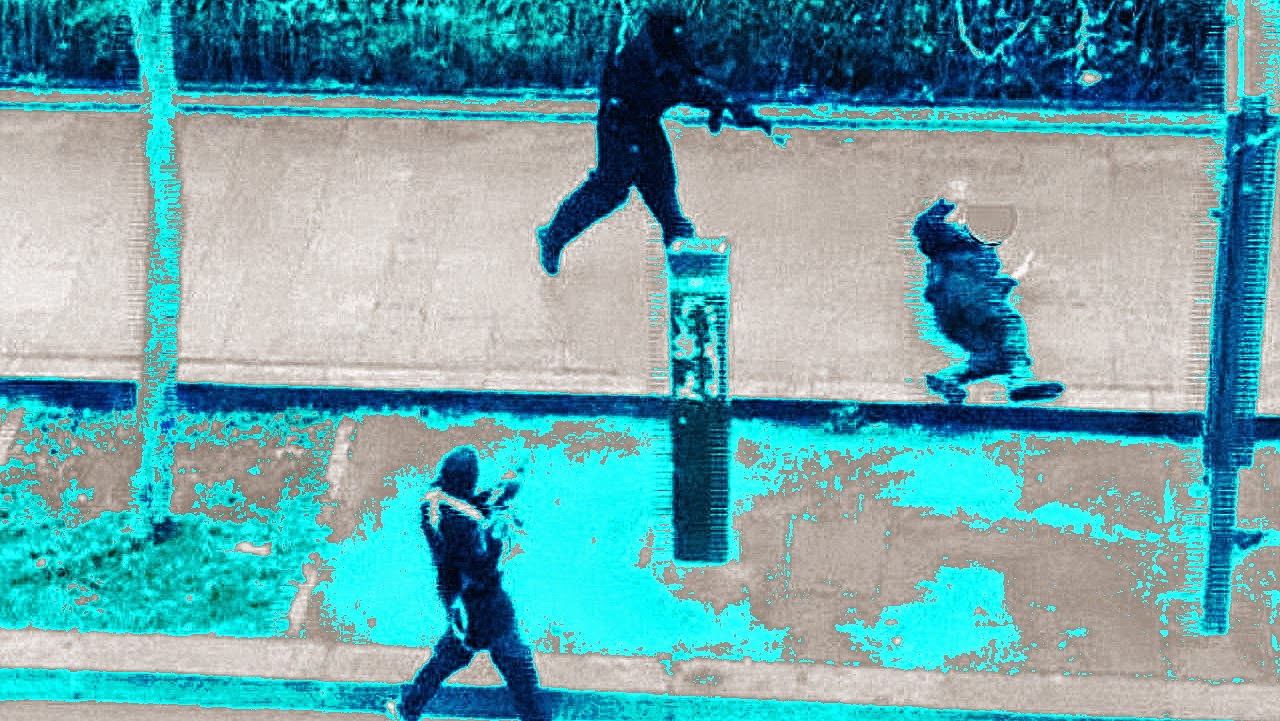
The same goes for the killings last month: it was relatively easy to identify with the
Charlie Hebdo
journalists, but it would have been much more difficult to announce:
‘We are all from Baga!’ (For those who don’t know: Baga is a small town
in the north-east of Nigeria where Boko Haram executed two thousand
people.) The name ‘Boko Haram’ can be roughly translated as ‘Western
education is forbidden,’ specifically the education of women. How to
account for the weird fact of a massive sociopolitical movement whose
main aim is the hierarchic regulation of the relationship between the
sexes? Why do Muslims who were undoubtedly exposed to exploitation,
domination and other destructive and humiliating aspects of colonialism,
target in their response the best part (for us, at least) of the
Western legacy, our egalitarianism and personal freedoms, including the
freedom to mock all authorities? One answer is that their target is well
chosen: the liberal West is so unbearable because it not only practises
exploitation and violent domination, but presents this brutal reality
in the guise of its opposite: freedom, equality and democracy.
Back
to the spectacle of big political names from all around the world
holding hands in solidarity with the victims of the Paris killings, from
Cameron to Lavrov, from Netanyahu to Abbas: if there was ever an image
of hypocritical falsity, this was it. An anonymous citizen played
Beethoven’s ‘Ode to Joy’, the unofficial anthem of the European Union,
as the procession passed under his window, adding a touch of political
kitsch to the disgusting spectacle staged by the people most responsible
for the mess we are in. If the Russian foreign minister, Sergei Lavrov,
were to join such a march in Moscow, where dozens of journalists have
been murdered, he would be arrested immediately. And the spectacle was
literally staged: the pictures shown in the media gave the impression
that the line of political leaders was at the front of a large crowd
walking along an avenue. But another photo was taken of the entire scene
from above, clearly showing that behind the politicians there were only
a hundred or so people and a lot of empty space, patrolled by police,
behind and around them. The true
Charlie Hebdo gesture would have been to publish on its front page a big caricature brutally and tastelessly mocking this event.

As
well as the banners saying ‘Je suis Charlie!’ there were others that
said ‘Je suis flic!’ The national unity celebrated and enacted in large
public gatherings was not just the unity of the people, reaching across
ethnic groups, classes and religions, but also the unification of the
people with the forces of order and control – not only the police but
also the CRS (one of the slogans of May 1968 was ‘CRS-SS’), the secret
service and the entire state security apparatus. There is no place for
Snowden or Manning in this new universe. ‘Resentment against the police
is no longer what it was, except among poor youth of Arab or African
origins,’ Jacques-Alain Miller wrote last month. ‘A thing undoubtedly
never seen in the history of France.’ In short, the terrorist attacks
achieved the impossible: to reconcile the generation of ’68 with its
arch enemy in something like a French popular version of the Patriot
Act, with people offering themselves up to surveillance.
The
ecstatic moments of the Paris demonstrations were a triumph of ideology:
they united the people against an enemy whose fascinating presence
momentarily obliterates all antagonisms. The public was offered a
depressing choice: you are either a flic or a terrorist. But how does
the irreverent humour of
Charlie Hebdo fit in? To answer this
question, we need to bear in mind the interconnection between the
Decalogue and human rights, which, as Kenneth Reinhard and Julia
Reinhard Lupton have argued, are ultimately rights to violate the Ten
Commandments. The right to privacy is a right to commit adultery. The
right to own property is a right to steal (to exploit others). The right
to freedom of expression is a right to bear false witness. The right to
bear arms is a right to kill. The right to freedom of religious belief
is a right to worship false gods. Of course, human rights do not
directly condone the violation of the Commandments, but they keep open a
marginal grey zone that is supposed to be out of the reach of
(religious or secular) power. In this shady zone I can violate the
commandments, and if the power probes into it, catching me with my pants
down, I can cry: ‘Assault on my basic human rights!’ The point is that
it is structurally impossible, for the power, to draw a clear line of
separation and prevent only the misuse of a human right without
infringing on its proper use, i.e. the use that does not violate the
Commandments.
It is in this grey zone that the brutal humour of
Charlie Hebdo belongs. The magazine began in 1970 as a successor to
Hara-Kiri, a magazine banned for mocking the death of General de Gaulle. After an early reader’s letter accused
Hara-Kiri
of being ‘dumb and nasty’ (‘bête et méchant’), the phrase was adopted
as the magazine’s official slogan and made it into everyday language. It
would have been more appropriate for the thousands marching in Paris to
proclaim ‘Je suis bête et méchant’ than the flat Je suis Charlie.’
Refreshing as it could be in some situations,
Charlie Hebdo’s
‘bête et méchant’ stance is constrained by the fact that laughter is
not in itself liberating, but deeply ambiguous. In the popular view of
Ancient Greece, there is a contrast between the solemn aristocratic
Spartans and the merry democratic Athenians. But the Spartans, who
prided themselves on their severity, placed laughter at the centre of
their ideology and practice: they recognised communal laughter as a
power that helped to increase the glory of the state. Spartan laughter –
the brutal mockery of a humiliated enemy or slave, making fun of their
fear and pain from a position of power – found an echo in Stalin’s
speeches, when he scoffed at the panic and confusion of ‘traitors’, and
survives today. (Incidentally, it is to be distinguished from another
kind of laughter of those in power, the cynical derision that shows they
don’t take their own ideology seriously.) The problem with
Charlie Hebdo’s
humour is not that it went too far in its irreverence, but that it was a
harmless excess perfectly fitting the hegemonic cynical functioning of
ideology in our societies. It posed no threat whatsoever to those in
power; it merely made their exercise of power more tolerable.
In
Western liberal-secular societies, state power protects public freedoms
but intervenes in private space – when there is a suspicion of child
abuse, for example. But as Talal Asad writes in
Is Critique Secular? Blasphemy, Injury and Free Speech
(2009), ‘intrusions into domestic space, the breaching of “private”
domains, is disallowed in Islamic law, although conformity in “public”
behaviour may be much stricter … for the community, what matters is the
Muslim subject’s social practice – including verbal publication – not
her internal thoughts, whatever they may be.’ The Quran says: ‘Let him
who wills have faith, and him who wills reject it.’ But, in Asad’s
words, this ‘right to think whatever one wishes does not … include the
right to express one’s religious or moral beliefs publicly with the
intention of converting people to a false commitment’. This is why, for
Muslims, ‘it is impossible to remain silent when confronted with
blasphemy … blasphemy is neither “freedom of speech” nor the challenge
of a new truth but something that seeks to disrupt a living
relationship.’ From the Western liberal standpoint, there is a problem
with both terms of this neither/nor: what if freedom of speech should
include acts that may disrupt a living relationship? And what if a ‘new
truth’ has the same disruptive effect? What if a new ethical awareness
makes a living relationship appear unjust?
If, for Muslims, it is not only ‘impossible to remain silent
when confronted with blasphemy’ but also impossible to remain inactive –
and the pressure to do something may include violent and murderous acts
– then the first thing to do is to locate this attitude in its
contemporary context. The same holds for the Christian anti-abortion
movement, who also find it ‘impossible to remain silent’ in the face of
the deaths of hundreds of thousands of foetuses every year, a slaughter
they compare to the Holocaust. It is here that true tolerance begins:
the tolerance of what we experience as impossible-to-bear
(l’impossible-a-supporter’, as Lacan put it), and at this level the
liberal left comes close to religious fundamentalism with its own list
of things it’s ‘impossible to remain silent when confronted with’:
sexism, racism and other forms of intolerance. What would happen if a
magazine openly made fun of the Holocaust? There is a contradiction in
the left-liberal stance: the libertarian position of universal irony and
mockery, making fun of all authorities, spiritual and political (the
position embodied in
Charlie Hebdo), tends to slip into its opposite, a heightened sensitivity to the other’s pain and humiliation.
It
is because of this contradiction that most left-wing reactions to the
Paris killings followed a predictable, deplorable pattern: they
correctly suspected that something is deeply wrong in the spectacle of
liberal consensus and solidarity with the victims, but took a wrong turn
when they were able to condemn the killings only after long and boring
qualifications. The fear that, by clearly condemning the killing, we
will somehow be guilty of Islamophobia, is politically and ethically
wrong. There is nothing Islamophobic in condemning the Paris killings,
in the same way that there is nothing anti-Semitic in condemning
Israel’s treatment of the Palestinians.
As for the notion that we should contextualise and ‘understand’ the Paris killings, it is also totally misleading. In
Frankenstein,
Mary Shelley allows the monster to speak for himself. Her choice
expresses the liberal attitude to freedom of speech at its most radical:
everyone’s point of view should be heard. In
Frankenstein, the
monster is fully subjectivised: the monstrous murderer reveals himself
to be a deeply hurt and desperate individual, yearning for company and
love. There is, however, a clear limit to this procedure: the more I
know about and ‘understand’ Hitler, the more unforgiveable he seems.
What
this also means is that, when approaching the Israeli-Palestinian
conflict, we should stick to ruthless and cold standards: we should
unconditionally resist the temptation to ‘understand’ Arabic
anti-Semitism (where we really encounter it) as a ‘natural’ reaction to
the sad plight of the Palestinians, or to ‘understand’ Israeli measures
as a ‘natural’ reaction to the memory of the Holocaust. There should be
no ‘understanding’ for the fact that in many Arab countries Hitler is
still considered a hero, and children at primary school are taught
anti-Semitic myths, such as that Jews use the blood of children for
sacrificial purposes. To claim that this anti-Semitism articulates, in a
displaced mode, resistance against capitalism in no way justifies it
(the same goes for Nazi anti-Semitism: it too drew its energy from
anti-capitalist resistance). Displacement is not here a secondary
operation, but the fundamental gesture of ideological mystification.
What this claim does involve is the idea that, in the long term, the
only way to fight anti-Semitism is not to preach liberal tolerance, but
to articulate the underlying anti-capitalist motive in a direct,
non-displaced way.
The present actions of the Israel Defence
Forces in the West Bank should not be judged against the background of
the Holocaust; the desecration of synagogues in France and elsewhere in
Europe should not be judged as an inappropriate but understandable
reaction to what Israel is doing in the West Bank. When any public
protest against Israel is flatly denounced as an expression of
anti-Semitism – that is to say, when the shadow of the Holocaust is
permanently evoked in order to neutralise any criticism of Israeli
military and political operations – it is not enough to insist on the
difference between anti-Semitism and criticism of particular policies of
the state of Israel; one should go a step further and say that it is
the state of Israel which, in this case, is desecrating the memory of
Holocaust victims, instrumentalising them as a way to legitimise
political measures in the present. What this means is that one should
flatly reject the notion of any logical or political link between the
Holocaust and current Israeli-Palestinian tensions. They are two
thoroughly different phenomena: one of them is part of the European
history of rightist resistance to the dynamics of modernisation; the
other is one of the last chapters in the history of colonisation.
The
growth of anti-Semitism in Europe is undeniable. When, for example, the
aggressive Muslim minority in Malmö harasses Jews so they are afraid to
walk the streets in traditional dress, it should be clearly and
unambiguously condemned. The struggle against anti-Semitism and the
struggle against Islamophobia should be viewed as two aspects of the
same struggle.
In a memorable passage in
Still Alive: A Holocaust Girlhood Remembered (2001), Ruth Klüger describes a conversation with ‘some advanced PhD candidates’ in Germany:
One
reports how in Jerusalem he made the acquaintance of an old Hungarian
Jew who was a survivor of Auschwitz, and yet this man cursed the Arabs
and held them all in contempt. How can someone who comes from Auschwitz
talk like that? the German asks. I get into the act and argue, perhaps
more hotly than need be. What did he expect? Auschwitz was no
instructional institution … You learned nothing there, and least of all
humanity and tolerance. Absolutely nothing good came out of the
concentration camps, I hear myself saying, with my voice rising, and he
expects catharsis, purgation, the sort of thing you go to the theatre
for? They were the most useless, pointless establishments imaginable.
We
have to abandon the idea that there is something emancipatory in
extreme experiences, that they enable us to open our eyes to the
ultimate truth of a situation. This, perhaps, is the most depressing
lesson of terror.
London Review of Books, http://www.lrb.co.uk/2015/02/05/slavoj-zizek/in-the-grey-zone